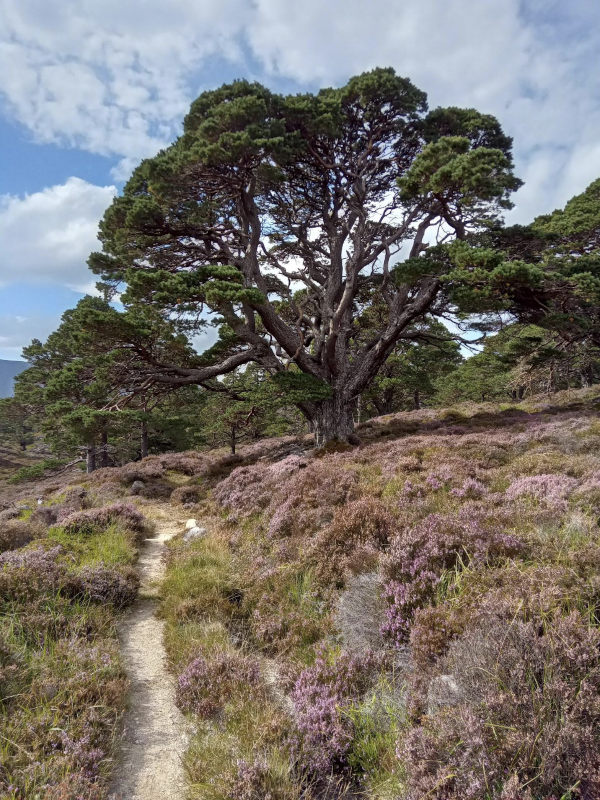
Granny Pine, Ballochbuie, August 2025. © Ken Thomson
Assiduous readers of Mountain Views will have noticed regular articles by George Allan and others about "developments" proposed in the uplands of the North East and elsewhere in Scotland. These include vehicle tracks, masts, hydro and other energy schemes, all of which should nowadays pass through official planning systems before construction. This article seeks to describe the work of George and his colleagues (see Editorial in this MV issue) over the years, in alerting NEMT members and others to proposals to which objections - or even sometimes support - may be raised.
Most new "building, engineering, mining or other operations in, on, over or under land, including changes in use", requires full planning permission (PP). Some developments (e.g. fencing no higher than 2m) enjoy `permitted´ development rights (PDRs) which allow work to take place without the planning authority being notified. However, some PDR developments (e.g. hilltracks and peatland restoration) require `prior notification/approval´ (PN/A) to the planning authority. For larger energy projects, there is a preapplication "scoping" stage, when it is decided what full - and especially environmental - information will be required.
According to one website (localplanningapps.co.uk):
The process to monitor planning applications is complicated, time-consuming, and prone to many human mistakes. The various planning authorities do publish the status of all their planning applications, but none of them make it easy to understand the data.
- and few of those involved would disagree!
The "complications" include:
Each local authority, and ECU, has its own planning website or "portal". Most are fairly easy to use, with an efficient Search function, and weekly/monthly lists of recent applications. Monitoring involves checking these lists each week, for applications of NEMT interest (if not previously picked up via informal public consultations or hearsay), and then deciding which require further investigation or action, e.g. submission of a comment or objection (sometimes requiring personal registration). Time limits for the public are short (usually 21 days) but some authorities do appear to exercise discretion. The posting and terminology of the information on these websites (and often its partial removal after deadlines have passed) are variable.
Each application carries a reference number, and a list of "Documents", e.g. the application form, maps or plans, a "Design and Access Statement" and "Supporting Information", often up to 30 files in number. There may also be "Constraints" such as relevant designated areas, "Comments", both from statutory consultees such as NatureScot and utility companies, and from private individuals or groups, and "Important Dates".
|
Granny Pine, Ballochbuie, August 2025. © Ken Thomson |
Developers and planners present information in various ways, but important points include:
Some remarks about the different kinds of development proposals follow:
Anyone can comment on a planning proposal, but comments must be "material": financial gains and losses, personal views about the applicant, and loss of private view, are not regarded as relevant, and will be ignored by the planners. On the other hand, a Local Development Plan, or a national policy, carries weight in supporting, objecting to, or modifying a proposal.
Monitoring and commenting on upland development proposals are essential to fulfil NEMT´s remit to "enhance, the upland, coastal and rural environments of Scotland". In doing so, George and his colleagues inside and outside the Trust are playing a vital part in trying to prevent or modify harmful schemes, both for individual proposals and within the wider scope of modifying policies and practices.
Please let the webmaster know if there are problems with viewing these pages or with the links they contain.