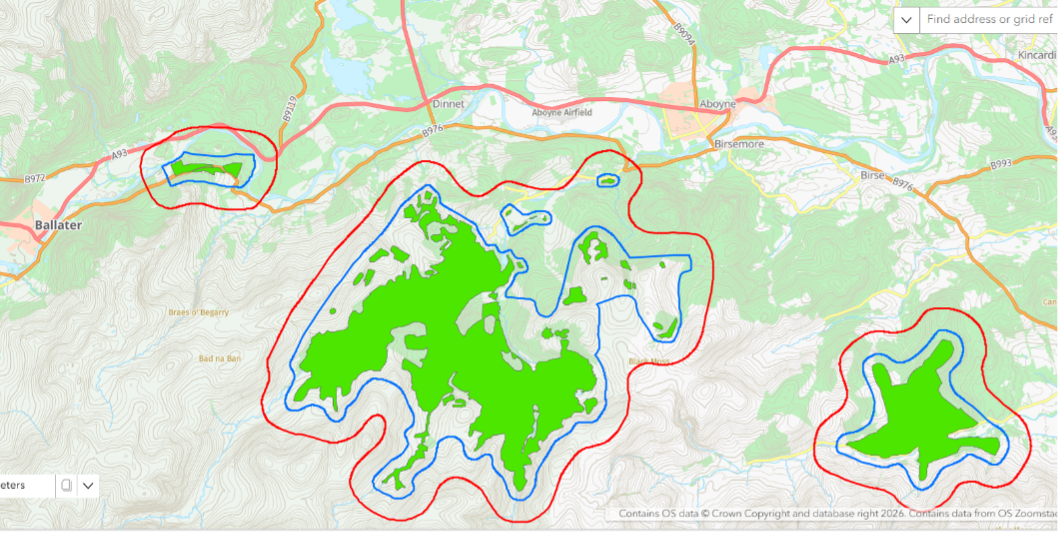
The Caledonian Pinewood Inventory sites at Torphantrick, Glen Tanar and Glen Ferrick with core areas (dark green), regeneration zones (blue line) and buffer zones (red line). Map credit Scottish Forestry.
The Scots Pine is Scotland's national tree, but while most people have heard of the Caledonian pinewoods, far fewer will have heard of the Caledonian Pinewood Inventory (CPI). In 1959, in their classic work The Native Pinewoods of Scotland, Steven and Carlisle listed and documented those pinewoods that were lineal descendants of those of early post-glacial times and had 'regenerated naturally'. Their list of the most ancient woods in Scotland was subdivided and expanded upon by the Forestry Authority in 1994, creating the CPI. This now includes 84 Caledonian Pinewoods covering a total of 179 sq km, a tiny fraction of Scotland compared to the 10,500 sq km of conifer plantation.
In the North East of Scotland, as well in Glen Tanar, Ballochbuie and Mar Lodge, the CPI includes smaller and less well-known pinewoods at Breda, Glen Ferrick, Torphantrick, Creag Ghuibhais, Crathie, Allt Cul and Glen Avon. While most of the larger woods have been designated as Sites of Special Scientific Interest, and some as Special Areas of Conservation under the EU Habitats Directive, smaller ones generally have no statutory protection.
In 2003 the Forestry Commission produced guidance on managing and conserving CPI sites, The Management of Semi-natural Woodlands. Native Pinewoods. This states that the woods on the CPI should be allowed to expand naturally 'where possible', and that 'planting should be the last resort'. It classified the CPI sites as core areas and introduced a 100m "regeneration zone" and a 500m "buffer zone" around these for expansion. In the buffer zones only seedlings from locally acquired seed can be planted, and no ground preparation is "preferred".
The Caledonian Pinewood Inventory sites at Torphantrick, Glen Tanar and Glen Ferrick with core areas (dark green), regeneration zones (blue line) and buffer zones (red line). Map credit Scottish Forestry.
However, the CPI management guidelines have done little to improve the condition of CPI sites. The evidence from Mar Lodge and Glen Feshie suggests the red deer population needs to be reduced to two per sq. km or less for natural regeneration to take off. Around most CPI sites, deer numbers are far higher than that. and sometimes there are sheep too, so that few sites are regenerating naturally.
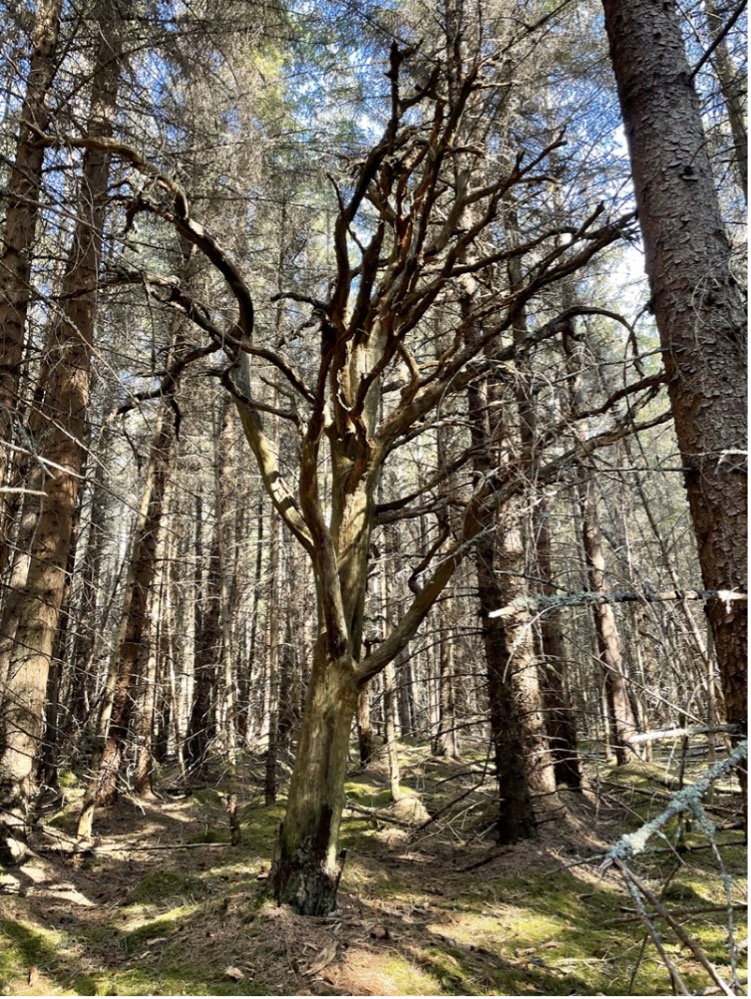
A dead Scots Pine overtopped by under-planted Sitka Spruce and Lodgepole Pine in what was once part of the Glenmore CPI. Photo credit Ron Summers.
Despite the recommendation that "planting should be the last resort", there has been much planting around and within cores, thereby blocking natural expansion, and compromising the integrity of cores. A survey of the CPI sites by Ron Summers reported in the journal Scottish Forestry in 2023 found that at Glen Ferrick, for example, there were young native trees planted in both the core areas and regeneration zones, as well as older native and non-native plantations in the regeneration zone. The result has been a significant number of the CPI woods, particularly those owned by Forestry and Land Scotland (FLS), have limited areas for expansion: 40% have old non-native conifers, 35% have old Scots Pine plantations, and 27% have young native woodland in the regeneration zones. Worse, many core areas (40%) have been invaded by non-native trees and rhododendrons though self-seeding.
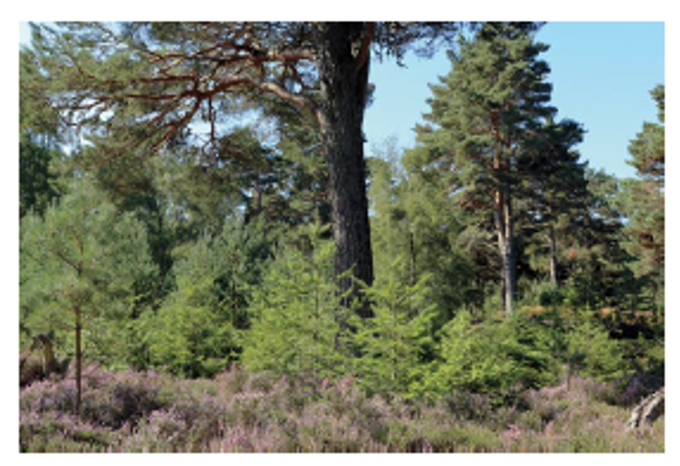
Douglas Firs establishing in Torphantrick Native Pinewood 2021. Photo credit Ron Summers.
There are also examples of directly damaging developments within the CPI zones, such as the Allt Mheuran Run of River hydro scheme in Glen Etive, and other damaging land management activities which are not covered by the existing guidance.
While Trees for Life has been busy trying to identify further sites to add to the CPI, the very survival of many of the existing CPI sites is under threat. The more non-native trees and shrubs become established in and around the CPI, the harder and more expensive will it be to restore them to their natural state.
While the charitable company Trees for Life has recently been busy identifying further sites to add to the CPI, the very survival of many of the existing sites is under threat. Decades of overgrazing is slowly killing many of the pinewoods and, as more non-native trees and shrubs become established in and around the CPI sites, the harder and more expensive will it be to restore them to their natural state. This has become more widely recognised and, after the 2024 conference in Fort William 'Scotland's Pinewoods: Ancient Roots, Modern Challenge', a network of people who are deeply concerned about the parlous state of the Caledonian pinewoods set out to develop a new conservation framework. In November 2025, our analysis and recommendations were published in Scottish Forestry.
Our recommendations start with a proposal that the current regeneration and buffer zones should be merged and extended up to the watershed to allow the pinewoods to expand up to the natural treeline. This would be a far more ambitious and ecologically coherent way to enable the Caledonian Pinewoods to expand within landscapes.
Within these much larger expansion zones — still only a small proportion of Scotland — we believe the focus should be on enabling the native pinewoods to expand through natural regeneration over time. The primary means to achieve this should be a compulsory large reduction in the size of the deer population. A ban on muirburn within the expansion zones would also be important in some of the eastern parts of Scotland to stop pine seedlings being consumed by fire. These measures would provide conditions for tree establishment and survival, and with fewer deer, there would be less need of deer fences, which kill Capercaillie and other woodland birds.
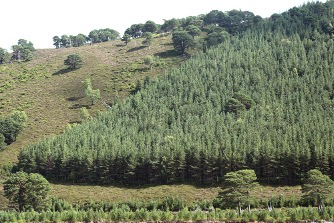
Scots Pine plantation in Glen Feshie, showing Caledonian Pines around and within the planted area. Photo credit Ron Summers.
We further argue that there should be NO new planting within these expansion zones, whether of native and non-native trees, that existing plantations should be removed, and where the ground has been cultivated, for example by ploughing or mounding, it should be restored. This should start with the removal of non-native tree species and shrubs such as Sitka Spruce and rhododendron, but over time should include native woodland plantations, whose uniform structure contrasts with the varied form of naturally regenerated forest.
Some of our proposals would require radical reform of the forestry grants system and how land-use within the CPI expansion zones is regulated. Given that CPI fragments would expand if deer numbers were reduced, we argue that public money should be spent on reducing deer numbers rather than paying landowners to plant native trees behind fences around CPI sites. We specifically recommend that ALL the CPI sites should be legally protected from damaging activities and no new tracks should be constructed in expansion zones. Furthermore, the current requirement on landowners to restock non-native forest plantations after felling would need to be changed. If it were replaced by a requirement on landowners to remove all self-seeded non-native trees within expansion zones, possibly with some grant assistance, that would make a huge difference.
The vision is to link and expand the isolated CPI sites in areas such as Deeside through the removal of plantations and natural regeneration. Given the location of many CPI sites, the Cairngorms National Park Authority could have a key role in delivering this. Having lost so much of our natural woodland over millennia, there is a moral imperative to re-establish much larger areas of natural native pinewood from the remaining fragments.
Please let the webmaster know if there are problems with viewing these pages or with the links they contain.