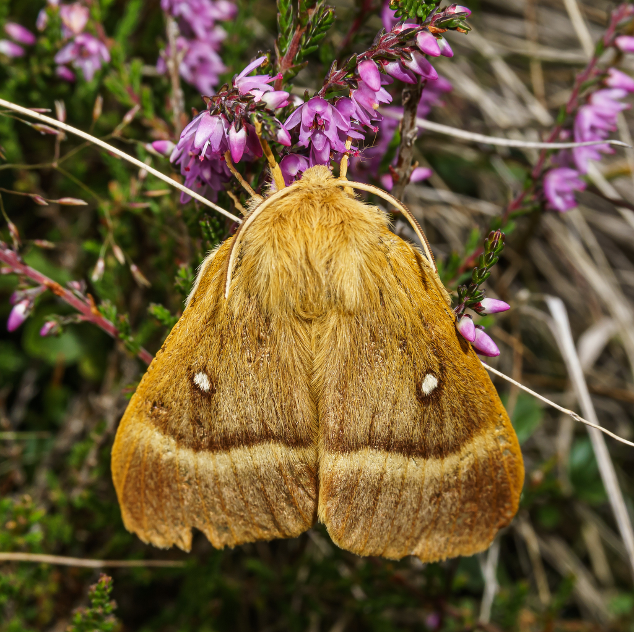
Oak Eggar, Morven
Eva Kupska, Volunteer Coordinator for the Outdoor Access Trust for Scotland (OATS), reported last autumn on this scheme, which assigns and trains volunteers as "custodians" for hill paths in the Cairngorms. Their path monitoring enables remedial work, minor or major, to be targeted. By the end of August 2025, all 40 routes had been adopted, by 33 "adoptees" (28 individuals and 5 groups, including 10 new sign-ups), and 26 path surveys had been completed. Eva also organised Path Maintenance Volunteering Days for those with the time, muscles and energy for minor restoration work.
In 2025, OATS arranged contractors to maintain and repair paths at: Chalamain Gap, Sron na Lairige, Braeriach, Carn Ban Mor and Mount Keen, rebuilding stone features, securing loose pitching stones, blocking braids, ditching and landscaping. At a cost of £300,000, repair work on the An Teallach path should be finished by March 2026. OATS also runs four car parks - at the Fairy Pools on Skye, Muir of Dinnet, Beinn a' Ghlo, and the new one at Stac Pollaidh, which has solar-powered ticket machines.
The Park Authority is undertaking a review of its Core Path Plan, to "reaffirm if the current network of core paths is sufficient to facilitate access across the National Park and if there are any significant gaps in the current network". A core path does not have to satisfy any specific standard, beyond not presenting a significant risk to users, i.e. a busy road, and designation does not necessarily mean that a path is upgraded or maintained by the Park Authority. Where there is no recognisable path on the ground, consideration would have to be given to how deliverable a potential new path is.
In summer 2025, an "informal consultation" was undertaken; locations of proposed amendments, and comments received, can be viewed on the cairngorms.co.uk website.
In December 2025, a "summary report" on the 208 responses received was produced (150 from Badenoch & Strathspey, 50 from Deeside), with the most popular matters of interest being at Nethy Bridge (Tulloch moor), Glenmore (Allt Mor to Cairngorm Mountain), Dulnain bridge to Balnaan, Kingussie (Speyside Way to Ruthven barracks), Aviemore - Carrbridge (proposed route), Newtonmore (Wildcat trail at Allt Laraidh gorge), Laggan (core paths on main roads), and core paths over private level crossings.
Over winter 2025/26, the Local (Park) Outdoor Access Forum was consulted and a draft Core Paths Plan produced. In April - June 2026, a 12-week formal public consultation will be undertaken, with the finalised Plan then submitted in the summer to the Scottish Government for adoption or further review if there are outstanding objections.
At their November 2025 AGM, ScotWays (aka the Scottish Rights of Way and Access Society) reported much healthier finances (i.e. back into surplus, after losses since 2020/21), thanks to generous bequests, legacies and donations, and rising income from solicitor searches. Sales of the 6th edition of the Scottish Hill Tracks book enjoyed "huge success". Paul Murton was elected as a new Honorary President, and Rachel Taylor elected as the new Chair. A new Director is Inverurie-based Greg Quinn; after a Foreign Office career, he runs Aodhan Consultancy Ltd., and is Volunteer Secretary of the community-owned GlenWyvis Distillery. Planned activities for 2026 include re-surveying and re-researching Heritage Paths, and repairing or replacing up to 100 Scotways signs.
Members of the Scottish Parliament ask questions of Ministers to elicit data and/or statements from the Scottish Government (SG); all Q&As can be found on the Parliament website. In the calendar year 2025, questions mentioning the following terms numbered: "deer" (usually management) 39, "mountain" (e.g. hares, rescue) 11, "hill" 14, "muirburn" 29, "peat" 12, "Cairngorms" 11, "wildlife" 64. Some of these groups may overlap, and some Q&As may be of marginal NEMT interest (e.g. farming).
A November 2025 Scottish Parliament Question (no. S6W-41642, from Murdo Fraser MSP) elicited the following information on income raised by sporting rates levied on shooting rights and deer forests. Such revenue is put into the Scottish Land Fund to help support community buyouts.
Estimated net income (£'000) from sporting rates, Scotland and Council areas over £100,000 per year, and Scottish Land Fund awards for community land and building purchase, 2020-21 to 2024-25
| Area | 2020-21 | 2021-22 | 2022-23 | 2023-24 | 2024-25 |
| Total Scotland | 2,121 | 1,676 | 1,509 | 2,452 | 2,084 |
| Aberdeenshire | 206 | 114 | 89 | 105 | 140 |
| Argyll & Bute | 316 | 194 | 257 | 219 | 253 |
| Dumfries/G'way | 202 | 175 | 154 | 94 | 103 |
| Highland | 597 | 485 | 404 | 935 | 587 |
| Moray | 125 | 102 | 73 | 184 | 123 |
| Perth & Kinross | 141 | 131 | 104 | 299 | 308 |
| Borders | 135 | 110 | 81 | 141 | 182 |
| Fund Awards (total Scotland) | 4,799 | 6,812 | 6,173 | 9,698 | 5,685 |
Source: Scottish Parliament website, Answer to Question S6W-41642
In November 2025, the Scottish Parliament passed the latest Land Reform Bill. It aims at creating new small landholdings, and at increasing the transparency of landownership and the land market. Ministers will have powers to split up landholdings of over 1,000 hectares when being sold ("lotting"), provided that it is in the public interest to do so: this may mean addressing depopulation, and promoting sustainability. Much remains to be detailed by secondary legislation, and some features may never come into effect. The campaigning organisation Community Land Scotland considered that the Bill "does not go far enough to meaningfully intervene in the land market and change the fundamental inequality of landownership in Scotland." However, large landowners will have to provide a 5-year Land Management Plan, to include communities to be engaged with: according to ScotWays, this "strengthens expectations around responsible land management".
Later that month, the Scottish Land Commission published its "ScotLand Futures" report, including findings from a survey of 1,200 self-selected respondents. Perhaps surprisingly:
The Commission will use these results to shape its 2026 advice to government on "completing Scotland's land reform journey".
Andy Wightman has issued his Who Owns Scotland 2025 report, analysing the pattern of private landownership in rural Scotland. He finds that
The report is available at https://andywightman.scot/docs/WOS_2025.pdf.
Oak Eggar, Morven
According to the Scottish Land Commission's Rural Land Market Data Report 2025, the estate market in 2024 was particularly subdued, with only 16 estate sales recorded (none in the North East), and only 6 sales over 1,000ha (but see below). Sales for natural capital and forestry suffered, probably due to policy uncertainty, while those for amenity held up. After the peak activity of 2021/22, forestry values dropped sharply from £15,327/ha in 2023 to £10,054/ha in 2024, although the volume of such sales stayed close to 2023 levels. However, data deficiencies — e.g. the growing trend of sales being registered with the non-monetary term "implementation of missives" (IoM), and time lags — make the land market picture incomplete, and less useful for land reform purposes.
The above numbers of sales are probably underestimates, due to the IoM device: in his recent report Rural Land Sales 2024, Andy Wightman finds that 39 landholdings "in scope" were sold in 2024, 16 larger than 500 ha, and 23 less than 500 ha but owned by owners who, consequently or already, owned in excess of 500 ha. Just under half of the total sold area was acquired by persons who already own land in Scotland: a key explanation for the ongoing concentration of privately-owned rural land. A total of 9 estates of over 1000 ha were sold, covering 36,090 ha and accounting for 80% of the hectarage of land in scope sold: these included the estates of Dorback (6080 ha), Glen Turret East (1966 ha), Strathfillan Forest (1,093 ha) and Bràigh Raithneach (5,317 ha). Sales in 2025 included Far Ralia in Speyside.
Andy received financial support from donors to elicit — at £30 each — the land values concealed by the IoM device. With the apparent support of Ministers, he is pursuing greater transparency with the Keeper of the Registers of Scotland.
The landowners' organisation Scottish Land & Estates (SLE) has called for a review of the Scottish Outdoor Access Code (SOAC, introduced in 2005), in view of the "many aspects of public access to the outdoors and activities that were (understandably) not considered when it was first drafted, such as ebikes, drones and rooftop tents". Other activities have grown in significance, such as metal-detecting, commercial access to the outdoors, Monitoring how the Code is working has fallen behind, and SLE are concerned that new legislation, such as deer culling requirements, may conflict with public access. SLE are also participating in a NatureScot-led review of the guidance relating to.
According to the MBA website, Culra bothy (which had been closed due to asbestos risks) on the Ben Alder Estate has now been demolished, with no shelter available nearby. A new bothy will be constructed on the same site in 2026.
Though not yet in any archive, Richard Genner, in his "Seeking Simple Shelter: Appendix for 2025", has once again provided much material on bothies — nearly all now gone. The 'Cairngorms and Eastern Highlands' chapter includes photographs of the Glen Einich bothies, Ryvoan, the Curran High Level Emergency Refuge, the Slugain bothy (not the Secret Howff!) in 1942, the Clach Bharraig bothy (near the Cairngorm ski road; disappeared around 1954), Upper Geldie Lodge, Altanour Lodge and Achelie (both in Glen Ey), the Chuckie bothy (about 2km before the Spittal of Glen Muick), and some "snippets" on the Monega bothy or bothies. At the end are some photos and text on the Dundee Ski Club Hut on Ben Gulabin, north of the Spittal of Glenshee. Richard can be contacted (rgatrg11@gmail.com) for an interesting read.
Scots pine is the most widespread and commercially important of the UK's three native conifers, providing a keystone for biodiversity. However, diseases and climate change present threats to the species and its woodlands. Recent work at the James Hutton Institute in Aberdeen and 3 other partners found that 1,589 species within the UK use Scots pine for either living or feeding on — 17 birds, 130 bryophytes, 539 fungi, 420 invertebrates, 468 lichens and 15 mammals. Of these, 199 fungi, 16 invertebrates and 12 lichens are obligates, i.e. they depend exclusively on Scots pine for survival.
As alternatives, 47 other tree species were examined to see how much of the Scots pine-associated biodiversity they could support. The most promising alternative species were sessile/pedunculate oak, European beech, and silver/downy birch, which all supported 15% of Scots pine-associated biodiversity. A total of 23 alternative species would be needed to support even 41% of Scots pine-associated biodiversity.
The study demonstrates that diversification of tree species will only provide improved resilience for a fraction of the biodiversity associated with the UK's Scots pine forests, and underlines the importance of protecting this vital species and its ecosystems. More on the JHI website, www.hutton.ac.uk.
A Ramblers Scotland survey of access authorities — 32 councils and two national parks — in 2025, 20 years after statutory access rights were established under the 2003 Land Reform Act and its Outdoor Access Code, found that:
On 13 February 2026, Nick Kempe posted on his ParksWatchScotland website "the first in a series of posts which looks at what forestry grants to large landowners to plant trees has done for native woodland in Scotland". That post reports on a plantation on Faochag in Glen Shiel — not in NEMT's usual patch, nor in a National Park, but still &hellips; This was established in the early 1990s, so long enough ago to judge the medium-term outcome, which it is safe to say Nick, and probably the rest of us, regards as unsatisfactory!
Gravitate North East, a non-profit mountain biking organisation, wants to develop Pitfichie Hill into a "world-class" downhill biking centre on Forestry & Land Scotland land near Monymusk, where a drop-in meeting was held on 28 February. At this stage, it's just a proposal, involving two new trails on the NE side of the Hill, each about 1.5km long and 2-3m wide, and a large car park/uplift centre yet to be located. While economic benefits are highlighted, there is local opposition to the increased traffic flows. NEMT Council considered the idea last autumn: it could not see a basis for full-scale opposition, since the new trails will be on a side of the Hill not much used by walkers.
Scottish Environment LINK (of which NEMT is a member), the RSPB and the Farming for 1.5 group have withdrawn from the Agricultural Reform Implementation Oversight Board (ARIOB) and its Development Group, citing Scottish Government (SG) failures in the farming policy process and decisions. These bodies were established by Ministers in 2021 to advise on the development of Scottish farming policy following the UK's departure from the EU. However, there has been little change in the £650 million paid annually to farmers, in apparent SG indifference to climate change and nature loss, issues which attract only about 5% of this total, compared to (e.g.) about 10% for the Less Favoured Area scheme which is direct income support for (mainly) hill farmers. Given that the E-NGOs emphasise their influence on and closeness to government, the move is a significant one.
Mobile provider O2 has become the first UK network to launch satellite-powered mobile data. Costing an extra £3 per month on a standard phone plan, the service connects compatible smartphones via satellite in areas where normal cellular coverage doesn't exist. Customers will be able to send text messages and use data across apps including WhatsApp, Messenger and Google Maps. Only some Samsung devices are currently supported, and the short list of compatible apps does not yet include several key information sources routinely used by climbers, skiers and hillwalkers. But broader device compatibility and more apps will follow, say the company. Such developments reinforce the case against the roll out of the Shared Rural Network programme of masts, tracks and power sources in remote unpopulated areas.
Please let the webmaster know if there are problems with viewing these pages or with the links they contain.