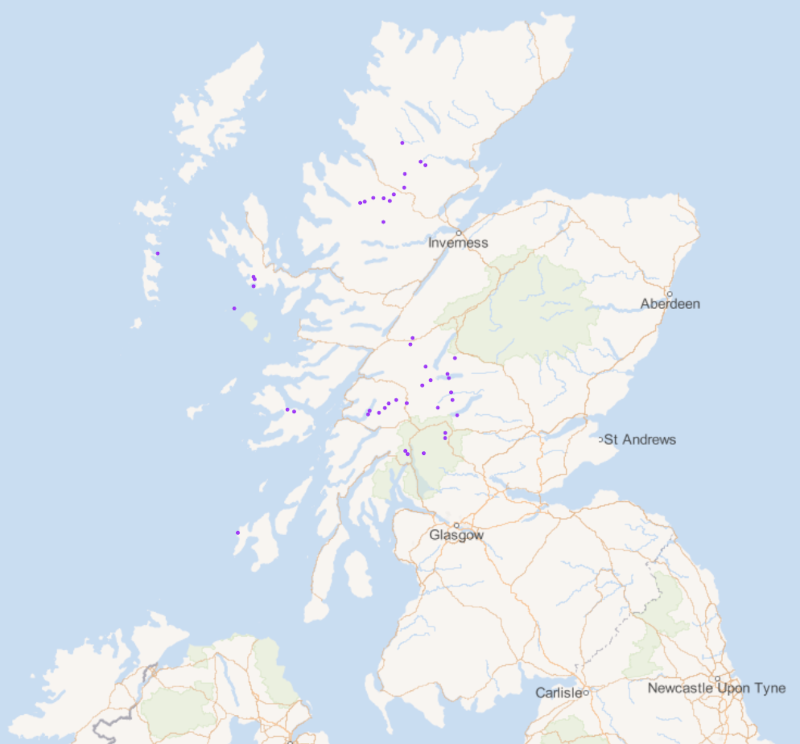
Proposed Total Not Spots Mast Locations. Source: srn.org.uk
A major victory
Campaigning to protect landscape is a frustrating business. Hill tracks in unspoilt glens are waved through the planning system, despite objections which challenge their purposes or highlight inadequate information. Comments made in response to government consultations are, in the main, ignored. It is, therefore, heartening to be able to confirm what was signalled in the last edition of Mountain Views, namely that the Westminster Government has undertaken a review of the Shared Rural Network (SRN) programme and the number of proposed masts has been radically reduced.
The original SRN plan included over 300 telecoms masts (subsequently reduced to 258) to cover so-called 'total not spots': areas with no mobile reception (at least according to the providers). While some of the sites chosen did cover habitation or road networks and were of no concern to NEMT, the great majority were in some of Scotland's finest remote landscapes, and would have little or no public benefit.
Following campaigning by several NGOs, the total not spot programme has been whittled down to 44. The attached map shows where it is now proposed to site these. There is no doubt that this is a major victory for environmental campaigning; it is on a par with past successes NEMT was party to, such as the preservation of the Longhaven sea cliffs from a super-quarry and the rejection of the plan to extend the Cairngorm ski area into Lurcher´s Gully. The mast campaign was co-ordinated by the John Muir Trust and Mountaineering Scotland, but NEMT has played a central role by writing to MPs, objecting to 84 individual planning applications, circulating information, and supporting (and occasionally chivvying!) others.
|
Proposed Total Not Spots Mast Locations. Source: srn.org.uk |
Why was the campaign effective?
It is worth reflecting on what made this campaign a success:
Is NEMT happy with the outcome?
The answer must be both yes and no. The result is much better that we had dared to hope at the beginning of the summer, when we thought that there might be a very limited pruning of the number of sites. It is particularly heartening that the Grampians have emerged pretty well intact, with plans for masts adjacent to Ryvoan bothy, close to Luibeg bridge and in Glen Tilt now abandoned. Further afield, many egregious proposals, such as two masts close together in upper Glen Nevis, have been withdrawn. However, the northern grouping of 'likely to go ahead' masts, as shown in the attached map, include clusters north east of Kinlochewe, around Loch Fannich and on the Glencalvie estate east of Alladale: these will serve little purpose and will have detrimental landscape effects. It is unclear why they have remained in the plan, unless it is simply to meet a land coverage percentage target. At the time of writing, NEMT is awaiting information about the exact location of masts in the southern Highlands grouping on the map. In addition, it is likely that masts which are planned for partial not spots, areas where there is some mobile coverage but not 4G, will go ahead, and this includes such horrors as one adjacent to the path up Creag Dhubh on Speyside.
Please let the webmaster know if there are problems with viewing these pages or with the links they contain.