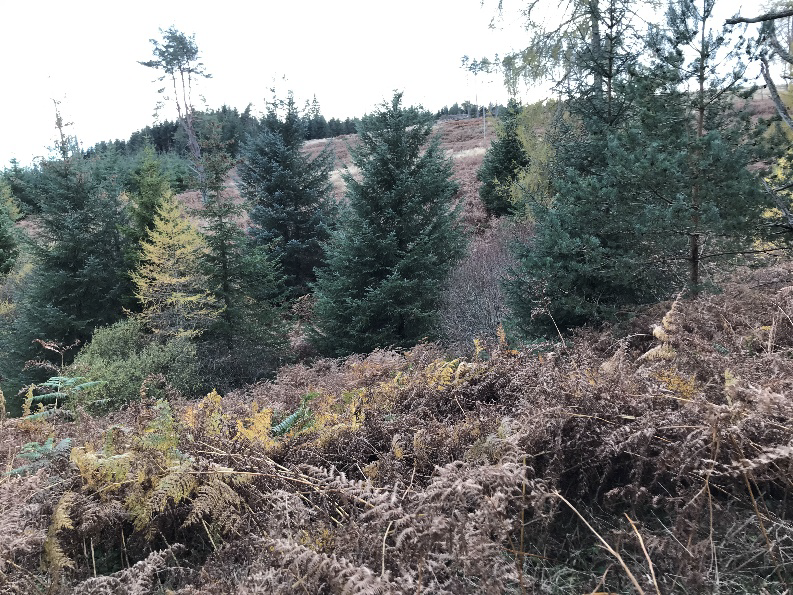
Sitka Spruce on Ben Vrackie, October 2024 © D. Watson
A walk up Ben Vrackie is a good day out when you are staying in Pitlochry. The way up the lower slopes is lined with a scattering of diverse trees. Among the self-sown birch there are others such as holly and oak that seem to have been planted through some local initiative. But there is another self-sown species whose presence I find increasingly foreboding: Sitka spruce. This is something that can be increasingly observed in the Scottish hills. If you take to the hills from east of Ballater up towards Peter Hill and towards Morven, you find whole hillsides colonised with young Sitka. And as a more advanced example of Sitka colonisation, a recent visit to Lochgoilhead area in Argyllshire showed fenced Sitka plantations up to the timberline - the altitude at which the rate of tree growth will yield an economic yield of timber. But above that lies the treeline - the altitude at which trees will still grow, and that was well colonised by scattered young Sitka that had effectively established lengthy young forests.
|
Sitka Spruce on Ben Vrackie, October 2024 © D. Watson |
The spread of invasive exotic species is a subject of widespread concern but, looking ahead a good few years, the spread of self-sown Sitka is surely the most significant - even most threatening! A recent publication by the Botanical Society of Britain and Ireland "Britain´s Changing Flora - A Summary of the Results of Plant Atlas 2020", considering the spread of Sitka, noted that it had the greatest estimated increase in range of any species covered by the project. It concluded that:
"Since the mid-20th century it has become the most widely planted commercial forestry species, especially on peaty soils in the north and west of Britain. Whilst many of the mapped records will be of planted trees, it has been increasingly found naturally regenerating. Since the mid-20th century it has become the most widely planted commercial forestry species, especially on peaty soils in the north and west of Britain. Whilst many of the mapped records will be of planted trees, it has been increasingly found naturally regenerating on moorlands distant from plantations, even at high altitudes. Its ability to regenerate successfully on peaty soils that are so vital for native biodiversity and carbon sequestration means that future planting of Sitka Spruce will need to be carefully controlled and managed to ensure that important peatland habitats, species and carbon stores are protected."
Sitka regenerating at nearly 600 metres on Clachmaddy Hill on the ridge above Glen Buchat (see below), nearly 300 metres above the nearest seed source, demonstrates the point. A further paper in 2023 concluded more than half of trees recorded above 900m recently are Sitka spruce.
If trying to restrain the spread of a problem like this, one would first of all remove the source of the problem and simultaneously remove the errant individuals. But the sources - Sitka plantations - are increasing under reforestation measures, and there are no effective measures in place to remove invasive populations. Few of the self-sown Sitka have yet reached the stage of seeding, but, as they do, the colonisation of open ground will accelerate. Whatever else muirburn or heavy grazing pressures did, they contained Sitka colonisation. A further twist is that the species revived under current efforts to revive native forests, chiefly birch species and Scots pine, are what is called "pioneer species." They colonise open ground. But pioneer species are shade-intolerant, and do not readily colonise established woodlands and forests. Sitka however is a species of the deep forest, shade tolerant, and hence readily invade Scots pine and birch stands. This can already be seen happening in parts of Glen Tanar.
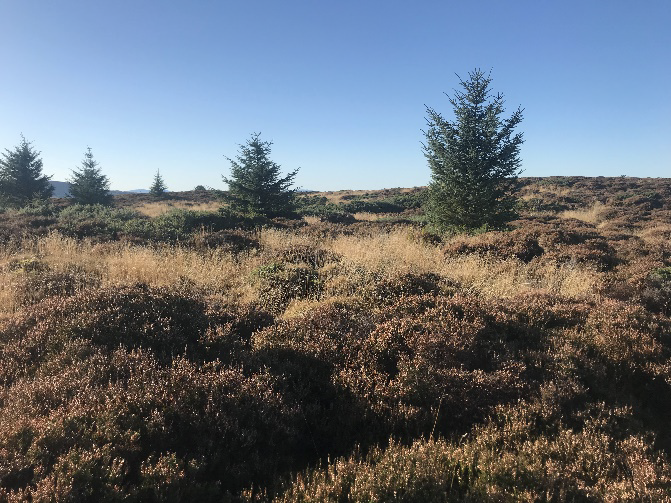 |
Sitka, Glen Buchat ridge, November 2024. © D. Watson |
Somehow, this growing problem has yet to be properly acknowledged, far less addressed with effective measures, although it would seem to be an appropriate one for the National Park Authority and Nature Scotland to address. Perhaps because nobody had yet to perceive how it may be effectively managed?
Please let the webmaster know if there are problems with viewing these pages or with the links they contain.