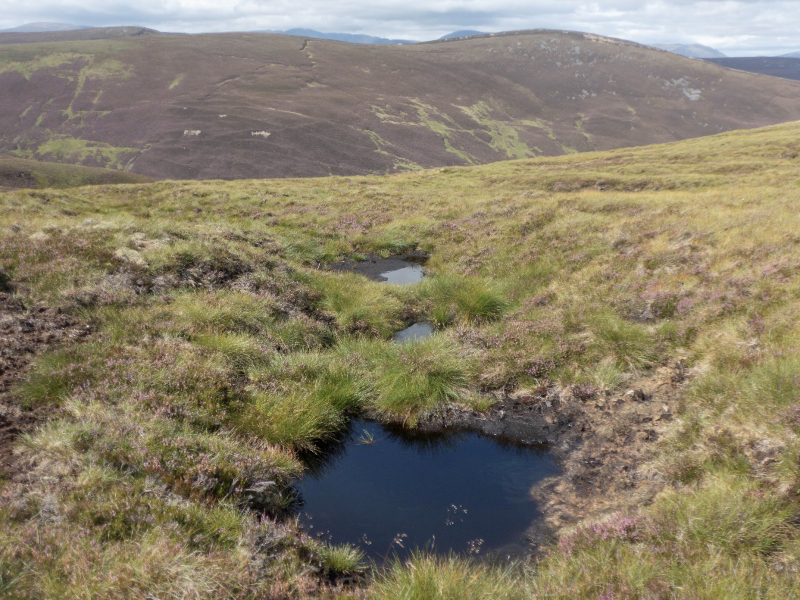
Peatland Restoration Pools, Carn Bhac, August 2025 © M. Duguid
|
Peatland Restoration Pools, Carn Bhac, August 2025 © M. Duguid |
More than 14,000 hectares (ha) of degraded peatlands have been restored across Scotland in 2024-25, a 42% increase over the 10,360 ha restored during 2023-24. The SG has pledged £250 million to support the restoration of 250,000 ha of peatlands by 2030, with an interim target of 110,000 ha by 2026. A total of 90,000 ha has been restored since 1990. (Scottish Rural Network Newsletter, June 2025).
The Public Local Inquiry into the proposed Hill of Fare windfarm is due to take place in Banchory Town Hall during the period 02/09/2025 - 11/09/2025.
Few new applications for hill tracks in the Cairngorms area have been submitted recently. Applications for two tracks in the Glen Lethnot area, submitted to Angus Council in 2023, have been approved. NEMT had objected but noted that the proposals created a dilemma. Apart from one section of new track, both applications were for constructed tracks along lines of braided and damaged soil created by the repeated use of ATVs: a formal track might be the lesser of two evils, given that the estate would be unlikely to cease a long-standing practice should the applications be refused. NEMT stressed the need to obtain Wild Land Area assessments and more information about potential borrow pits, along with greater clarity about track widths and the importance of a central vegetation strips to reduce visual impacts. It is good to report that these suggestions have all been dealt with in the approvals: an example of how raising detailed concerns, even where approval of a track is likely, pays dividends.
Scottish Environment LINK, founded in 1987 as the "forum for Scotland's voluntary environment community", with Drennan Watson as its founding chairman for 5 years, has acquired its 50th organisational member. NEMT - also founded by Drennan, along with Adam Watson and others - has been a member since its inception. Its current CEO is Dr Deborah Long, and it has 11 staff and 9 trustees. It keeps in close contact with the Scottish Government and its agencies, and publishes regular updates on all policy matters relating to the Scottish environment.
Wildfires are a complex issue, ranging from small-scale incidents in the urban fringe to large areas of moorland and forest, occurring on different soils, and with different areas and intensities, depending amongst other things on land management such as muirburn. Major incidents are often due to muirburn getting out of control rather than to campfires etc., although of course the latter are a frequent source of risk. A 2022 NatureScot report (no. 1302; Holland et al.) found evidence that, across the UK, perhaps 15 to 60% of burns escape as wildfires. However, in Scotland, 96% of the total wildfire area in 2018-2020 occurred outside moorlands managed by muirburn (Fielding et al., Biol. Cons., vol. 296, 2024).
On 27 June, the Cairngorms National Park Board approved an Integrated Wildfire Management Plan, and it is "taking forward" actions to deal with this problem. The Park Authority has awarded £270,000 of funding from its Climate Adaptation Fund for 12 projects, including:
A proposed seasonal bye-law for the Cairngorms is still with Scottish Ministers for their approval.
Summer is a popular time to "consult": at time of writing, the following Scottish Government ones (there are others) are out there for you to participate in, at least until the indicated closing dates. Details can be fairly easily found on the SG website:
and umpteen sub-surveys as part of the Scottish Rural Communities Policy Review (though you have missed them: the closing date was 31 August!) on Community-led Local Development; Scottish Rural Network; Scottish Rural Acton, with invitations to the general public, youth, and "demographic".
A Scottish Government research report (McKee et al., 2023) has examined the socio-economics of land ownership and management for nature restoration, natural capital, and/or carbon sequestration. The authors found that this usually involved afforestation, ecological restoration (e.g. rewilding, or peatland), or renewable energy schemes.
Actual or perceived benefits included community engagement with estate activities, support for education, training and local initiatives, and increased tourism, while negative impacts included loss of farm/estate jobs, outmigration and reduced local services (e.g. schools), threats to recreation and landscapes, and risks (e.g. wildfires).
The researchers recommended that:
Ramblers Scotland was founded in 1965, with the Diamond Jubilee being celebrated by several events across Scotland. Membership numbers have increased over the years, and funding from the People's Postcode Lottery, the Scottish Government and others has enabled several innovative and engaging projects to attract all ages and abilities of people to enjoy the countryside, with specific focus on inclusion, to ensure that walks are welcoming to everyone. In addition, successful campaigning for improved paths and trails across the country is done in conjunction with other outdoor voluntary organisations and agencies.
There are 54 Groups of members across Scotland with local groups in Aberdeen, Stonehaven, Inverurie and Moray. More recently, the Aberdeen Young Walkers group has been formed. The walks organised locally are popular, with leaders all having undertaken Walk Leadership training.
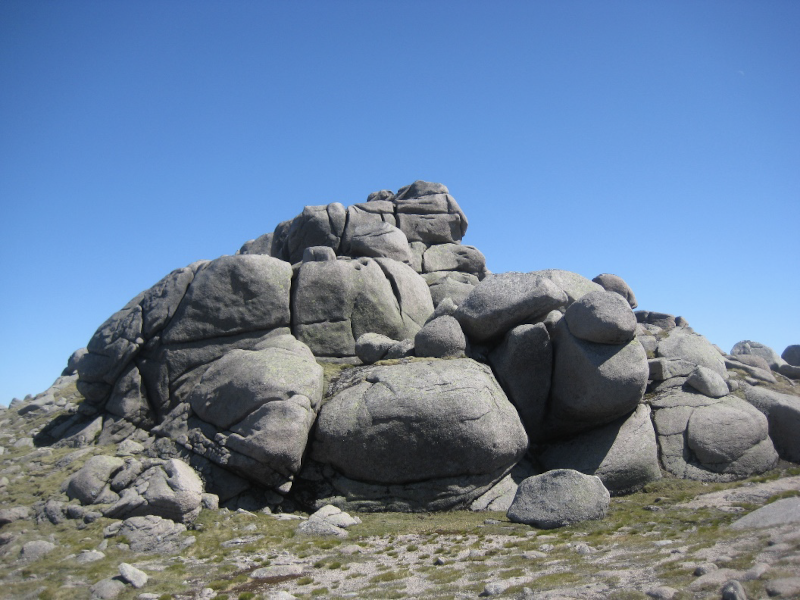 |
Rock Formation, Ben Avon © Ken Thomson |
Please let the webmaster know if there are problems with viewing these pages or with the links they contain.