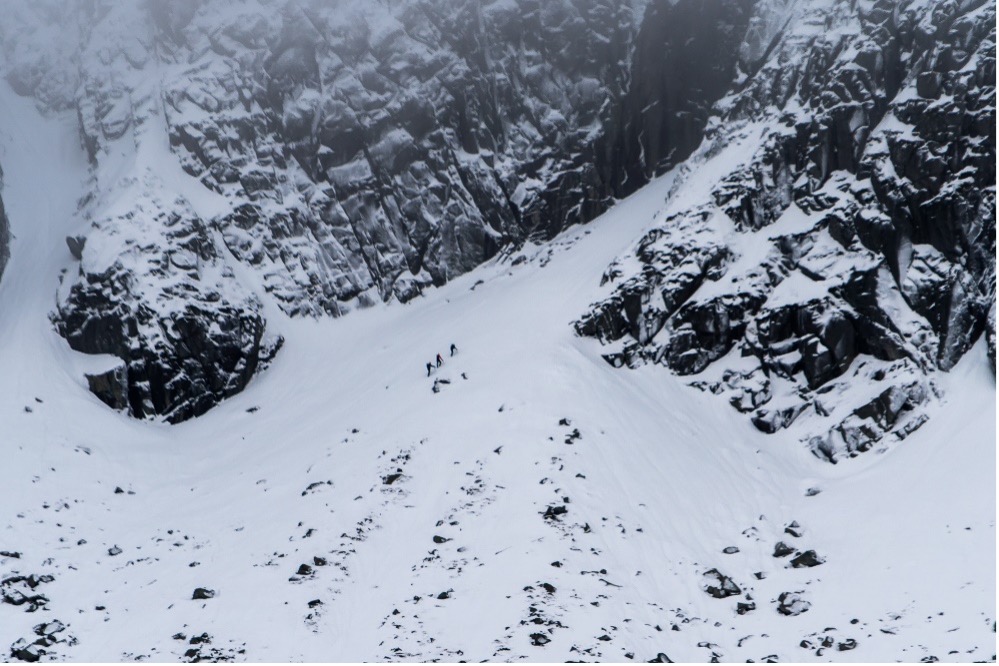
Approaching the Black Spout, January 2026 © Jamie Vince
Wildfires have become of increasing concern both in Scotland and the UK more generally, and around the world.1 In 2025, over 15 wildfire alerts were issued in Scotland, 241 wildfires (not all in the uplands) were recorded (109 in April alone), and the Scottish Fire and Rescue Service (SFRS) attended over 200 such incidents. Following the extensive Carrbridge - Dava Moor fires,2 much official attention was devoted to assessing the situation across Scotland and to preventing and improving "resilience" to future outbreaks. A Scottish Government (SG) "Wildfire Summit" was held in October 2025 at Grantown- on-Spey. Chaired by two ministers, the invited attendees included SFRS, NatureScot, and some land managers and environmental organisations.
The Strategic Action Plan on Wildfires recently published as a result says: "Wildfires are no longer rare or predictable events. They are a growing, climate-driven threat ... ". Under the Plan's aim of Prevention, the Cairngorms National Park is to operate its new bye-law banning unlicensed fires and barbecues in public places between 1 April and 30 September every year, and this may be extended to other local authorities. Under Preparedness, equipment (including helicopters) and insurance are mentioned, while under Response, "a mountain rescue-style multi-stakeholder response model, with trained wildfire volunteers, to support local efforts when called upon" is to be considered, and may be trialled in the Park.
Wildfires in Scotland are classified by SFRS as "large and uncontrolled outdoor fires exceeding 1000 sq.m. of burned area".3 This area (10m by 100m, or 0.1ha) excludes many smaller fires which may become 'wild' but do not spread to that extent, because either they are controlled, or local inflammable material is lacking. Also, while most large fires are reported, and receive SFRS attention and resources4, others may be dealt with by local landowners without formal reporting. Satellite coverage provides data, but is not well linked to ground- based observations, e.g. a 30ha resolution omits many UK wildfires.
Though lightning may sometimes be responsible for starting wildfires, human activity is nearly always to blame: barbecues, cigarettes, or muirburn and other deliberate fires getting out of control5. The lowest estimate of wildfires started by muirburn getting out of control seems to be about 24%6; higher estimates range up to 60%. By nature, wildfires are unplanned (unless provoked by arson) and largely unpredictable, but they usually happen in areas with combustible vegetation that causes flames to spread rapidly. On moorland, peaty soil fuels the flames, and threatens 'holdover' or 'zombie' fires which hinder extinction.
Wildfires can be assessed in various ways, e.g. by number or area, or by exposure (risk) or actual impact on populations (human and other), physical assets (such as buildings), carbon emissions, or air quality (e.g. health). Further aspects involve intensity (energy release, often measured by flame length) and severity (general impact), and shorter and longer-term effects. And of course there are the almost unmeasurable effects such as fear, and degradation of landscape, water and soil (including depth). In the UK uplands, many of the most fire-prone habitats are in areas designated for high-quality ecosystems as AONB, SSSI, SPA, SAC or Ramsar sites.
Some local North-East evidence may be of interest. The Mar Lodge Estate National Nature Reserve 2023 Annual Review included:
It was a very challenging start to our fire patrolling season, with high or extreme fire risk in May/June and a surge of irresponsibly lit campfires. Between 30th May and 18th June we needed support from other estate departments to undertake daily evening patrols, which put considerable pressure on estate staff. We otherwise undertook our regular fire patrols between April and October. This year we found 94 campfire sites, an increase of 40% on 2022. Of the 30 'hot' fires that we encountered (and extinguished) during high or extreme risk conditions, two were unattended and burning freely through the ground. Fire bowl usage continues to increase - 22 this year (8 of which were lit during high/extreme risk periods) vs 13 last year.
and from the 2024 Review7:
We encountered 67 campfire sites, which is 29% fewer than last year. Fire bowl usage continues to increase - up 14% - as does the use of disposable BBQs. Despite the damp weather, an abandoned campfire in Glen Lui was found smouldering through the pine woodland, which took a fair few buckets of water to extinguish. Unlike 2022 and 2023, there were no high fire risk periods during the spring or summer. Our only high fire risk period came in the third week of September.
The 2025 Review records 60 campfires, a welcome further drop, perhaps due to increased fire patrols, amidst a record 51 days under High Fire Risk warnings. For 2026, it is hoped that a new Estate wildfire management plan, more equipment (including a drone bought for deer management purposes, but useful in detecting underground fires), more staff training, and the new National Park bye-law, coupled with further public education, will continue to drive down these numbers.
Wildfires are of course not a uniquely Scottish problem: England and Wales have experienced similar problems in their uplands, with a record number of about 1,000 wildfire incidents in 2025. Europe-wide, the 2021-24 FirEUrisk project, with 38 consortium partners, aimed at a unified European response to an increasing hazard", taking account of both the environmental context and socio-economic circumstances. And globally8:
"A total of 3.7x10⁶ km2 burned globally during the 2024-2025 fire season [March-February], ... ranking 16th of all fire seasons since 2002. Despite the relatively low area burned, global fire carbon emissions were ... the sixth highest on record, driven by intense and high-emission fires in South America and Canada. This pattern reinforces a trend towards growing fire impacts in carbon-rich forest ecosystems ... Europe recorded its fourth-lowest burned area since 2002, with 30 000 km2 burned (49% below average) and C emissions 22% below average. However, there were stark regional contrasts", e.g. Portugal, with 1370 km2 burned, 16 fatalities and EUR 180 million in damages.
In Scotland, muirburn remains a contentious issue, both for its effects on landscape and wildlife, and for the frequency of loss of control. Scottish Ministers have postponed more than once implementation of a licensing scheme, while "the evolving science on muirburn and its effect on peatland and wildfires is considered".
Stop Press: as this issue of Mountain Views goes to the printer towards the end of March 2026, the overall fire danger assessment for North and North East Scotland, based on Ignition Potential as measured by the Fine Fuel Moisture Code, is reported as "Very High".
Approaching the Black Spout, January 2026 © Jamie Vince
1 For example, researchbriefings.files.parliament.uk/documents/POST-PN- 0717/POST-PN-0717.pdf, wildfire-lab.com, www.ukclimaterisk.org/wp- content/uploads/2021/06/UK-Wildfires-and-their-Climate-Challenges.pdf, www.rsfs.org.uk/index.php/component/content/article/wildfire- special?catid=104&Itemid=101.
2 The Carrbridge-Dava fires in early July 2025 covered about 10 ha (25 acres): see https://www.scottishwildfireforum.co.uk/newspost/swf-statement-on- morayshire-wildfires, and were reported as caused by flares used on a helicopter training exercise. On 9 October 2025, a much smaller wildfire, apparently caused by muirburn, occurred on Culblean Hill above Loch Kinord on Deeside. See the blogsite parkswatchscotland.
3 Alternative definitions include 'any uncontrolled vegetation fire which requires a decision or action regarding suppression', sometimes plus (i) an area of at least 1 ha, (ii) sustained flame length over 1.5 m, (iii) at least 4 committed fire appliances, (iv) at least 6 hours of committed resources, (v) a serious threat to life, environment, property and infrastructure.
4 "Analysis of Fire and Rescue Service (FRS) data has shown that annual response costs for fires in 2009/10 and 2010/11 amounted to £55 million alone and can be very much larger in years with prolonged hot dry periods" (see UK Wildfires and their Climate Challenges Climate Change Committee 2021).
5 Glass magnifying sunlight on dry vegetation has been blamed, but experiments were not "successful": see Wittich, P. and Muller, T. (2009) An experiment to test the potential for glass fragments to ignite wildland fuels, Int J Wildland Fire 18 (7): 885-891.
6 See Holland, J.P. et al. (2022) Reviewing, assessing and critiquing the evidence base on the impacts of muirburn on wildfire prevention, carbon storage and biodiversity. NatureScot Research Report 1302. Scottish Parliament Question (S6W-41287) "Scottish Fire and Rescue Service data reportedly indicating that intentional muirburns that have got out of control have been the fourth biggest cause of primary wildfires in the Highlands and Islands over the last five years".
7 Mar Lodge Estate National Nature Reserve 2024 Annual Review: see https://www.nts.org.uk/stories/mar-lodge-annual-review.
8 Kelley, D. I. et al., State of Wildfires 2024-2025, Earth Syst. Sci. Data, 17, 5377- 5488, https://doi.org/10.5194/essd-17-5377-2025.
Please let the webmaster know if there are problems with viewing these pages or with the links they contain.