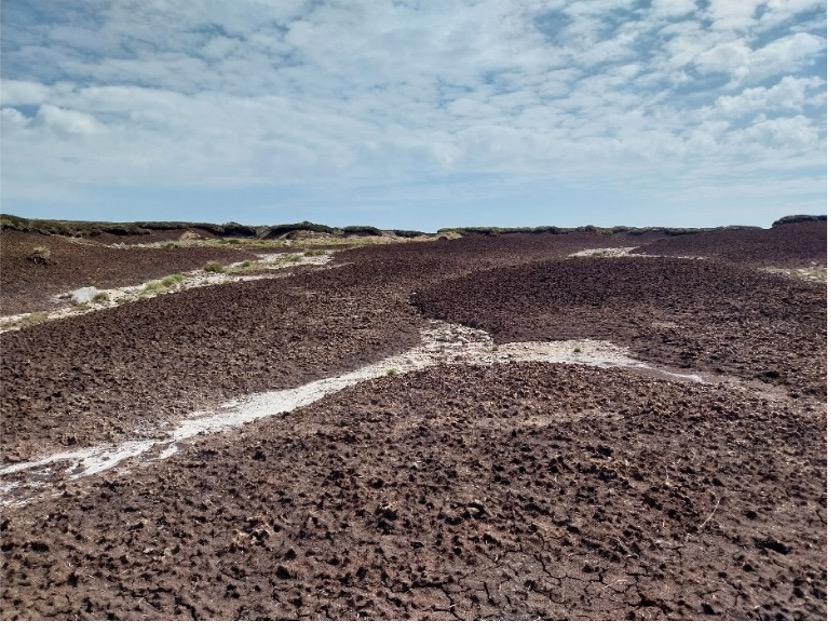
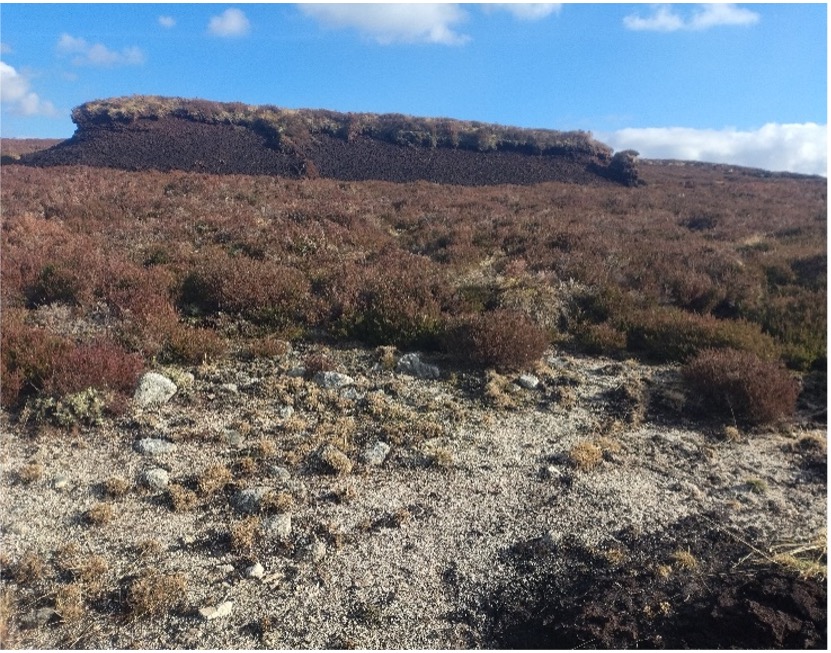
Bare Peat Pans near the Hill of Badymicks summit, Autumn 2024. Photo credit Scottish Woodlands Ltd.
Walking east from Clachnaben, crossing the summit of the Hill of Badymicks and going up towards Mount Battock, you will find some of the most degraded peatland in Scotland. The 'moonscape' of hags, gullies and bare, mineral pans characterise decades of degradation resulting from combining impacts of overgrazing, burning and artificial drainage accelerated by temperature extremes and wind erosion. The landscape is stark, but between the deep gullies and cavernous hags, bog pools and hummocks of sphagnum mosses remain, intact fragments of a once more uniform peatland blanket covering the hillside.
Over the last few years, work has begun on a landscape-scale recovery project aiming to improve the condition of the Glen Dye Moor peatland, seeking benefits to water quality, biodiversity and halting ongoing loss of stored peatland carbon. An intensive programme of restoration works using low- ground-pressure machinery will provide initial physical interventions, stabilising the bare peat, and slowing the flow of water run-off with dams and bunds. These physical interventions work to generate the conditions which allow the site to 're-wet', enabling bog vegetation such as Sphagnum mosses and cotton grass to re-colonise from fragments across the Moor, aiming to re- establish peatland function.
The peatland restoration works started at Glen Dye Moor in November 2023, with funding from NatureScot's nationwide Peatland ACTION programme. Initial phases have worked on over 500 ha of degraded peatland in the South of the estate, extending East and Northwest of the Cairn o' Mount viewpoint on the B974 road. Operator teams have blocked artificial drains, dammed and reprofiled hags and gullies, and re-turfed areas of bare peat using specialised low-ground-pressure machinery.
Bare Peat Pans near the Hill of Badymicks summit, Autumn 2024. Photo credit Scottish Woodlands Ltd.
Phases One and Two areas are now 'on the road to recovery', with active peatland carbon loss halted and the conditions established to allow a functional peatland vegetation community to re-colonise. The wetter conditions are immediately evident, and the landscape now features many new pools holding water in previously eroding hag and gully systems. These new pools already support aquatic invertebrates and amphibians, providing a food source for wading birds and a water supply in drier summer months. The work areas in these phases are now under validation with the IUCN Peatland Code, a voluntary certification scheme that can help landowners and businesses fund peatland restoration.
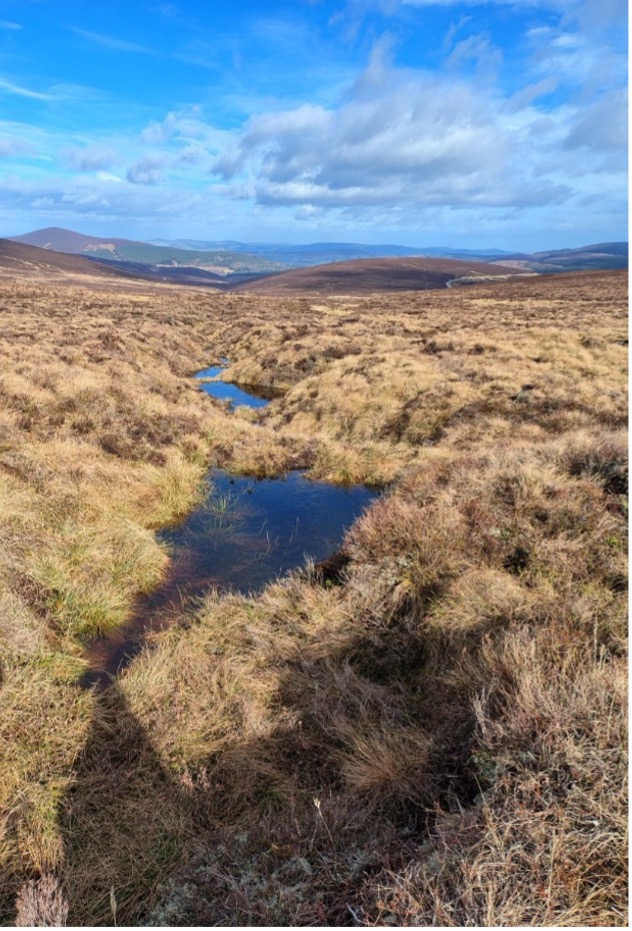
Reprofiled Gully with Pools, March 2026. Photo credit Scottish Woodlands Ltd.
As part of the Peatland Code process, the project areas will undergo regular monitoring using drone photography as well as site visits from the Scottish Woodlands team to ensure that the peatland recovery stays on track for decades to come. We also plan to set up a water table monitoring project in the restored area Northwest of Cairn o' Mount; this will assess how water levels change throughout the year on the newly restored peatland and can be compared with the un-restored parts of the estate to explore how the interventions have returned the site to wetter conditions.
So far, restoration work has mainly taken place over pathless areas to the East and West of the B974, not generally popular for hillwalkers, but future phases will bring operations closer to the popular Clachnaben hill paths. Work on the third Phase of restoration began in September 2025, starting restoration of the main peatland area in the North of the estate covering ~1000ha between the summits of Mount Battock in the West and Mount Shade in the East. In the next phases, contractor teams will tackle over 700ha of degraded peatland and start stabilising the extensive network of erosion between the summits. This active restoration work may be visible to the thousands of people who use the hill path every year for hillwalking, cycling and running.
Repairing the Glen Dye Moor 'moonscape' is a complex challenge. We aim to build on guidance from similarly severely degraded sites in the Peak District and Pennines, and to employ the full palette of restoration techniques, in order to give the area the best chances of recovery. While the moonscape may never return to a uniform, thick blanket bog, interventions are still essential to stabilise the area to protect the more intact peatlands below, and to buffer the wider waters of the Dye and River Dee catchment from further erosion in years to come.
Low ground pressure machines work on a feature near Meluncart Hill, March 2025. Photo credit Scottish Woodlands Ltd.
The peatland restoration work will complement the proposed new woodland creation project aiming to transform approximately 3,000 hectares of former sporting estate into a diverse forest landscape. The plan follows a "right tree, right place" philosophy, splitting the new woodland into two primary components: two-thirds native woodland designed to restore natural habitats (such as upland birch and Caledonian Scots Pine) and one-third productive conifer crops to support sustainable timber production.
This balanced approach is expected to sequester roughly 780,000 tonnes of CO2e over its lifetime, significantly contributing to Scotland's net-zero targets while providing sustainable timber products, creating local employment and supporting the rural economy.
This woodland initiative is designed to work in tandem with the extensive peatland restoration to offer significantly greater benefits than if they were stand-alone projects. Careful surveying and mapping of the proposed woodland creation areas ensures that any sensitive features, habitats and protected species are taken account of in the design and preserved and enhanced through delivery of the project.
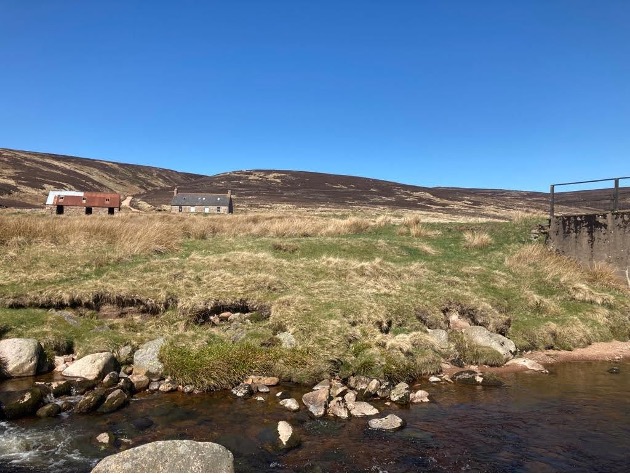
Charr Bothy on the Water of Dye, Summer 2022. Photo credit Scottish Woodlands Ltd.
To find out more about the peatland restoration and woodland creation at Glen Dye Moor, please follow the updates page at https://glendyemoor.com/updates/.
NatureScot Peatland ACTION also filmed a case study video of the work at Glen Dye Moor last autumn which can be viewed on YouTube.
Please let the webmaster know if there are problems with viewing these pages or with the links they contain.