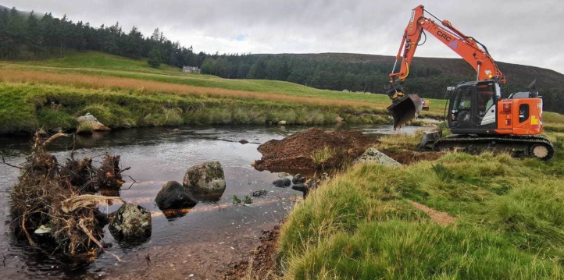
Placing Large Wood Structures in the Upper River Dee
I'm sure that readers of Mountain Views cannot have failed to notice the many thousands of dead trees now being placed into our NE rivers as improvement measures. This restoration method is known as the placement of Large Wood Structures (LWS). I wonder what you think of this sort of intervention? I have a long-standing interest in how our rivers are managed and restored, both as a professional scientist specialising in aquatic ecology and as the Scottish judge on the awards panel for the annual UK River Restoration Prize.
The theory goes like this: most of our upland rivers have been denuded of their natural riverbank woodlands for a century or more; the dead wood that these woodlands supplied to the river has largely disappeared; this natural material supported river ecosystems through both physical and biological mechanisms; and until the woodlands are re-established, a stop-gap is to introduce the wood through, for example, the placement of felled or windblown trees and, thus, supporting the damaged ecosystems, including aquatic insects and fish. LWS are considered to improve habitat diversity by re-directing local flows and creating more pools and riffles, providing food resources for river invertebrates and, thus, food for fish and shelter from predation.
However, there are some downsides. The placement of hundreds of trees along stretches of our highland rivers sometimes does not look pretty, and I've had landowners complain to me that they hadn't realised how unattractive this was going to be. Anchoring the trees requires significant engineering by machine, digging a deep trench in the river bank and placing large boulders from the river channel on top. Some well-regarded hydrologists have pointed out that some of these massive boulders have been there since the last glaciers retreated, and feel that we are vandalising these spectacular river channels. Misplaced or poorly anchored wood can wash down the river channel and block flows at choke points, such as bridges, and contribute to flooding. LWS can also cause unintended erosion of river banks, and I have seen this myself. The technique requires very careful assessment, understanding of consequences, and continuing management.
The question is: do the benefits outweigh the downsides? The use of LWS in lowland agricultural areas, in straightened rivers undergoing restoration to reconnect them to their floodplains by persuading them to begin natural meandering, has been shown to be hugely beneficial for biodiversity and natural flood management. There are some well-designed research projects which show these physical and ecological benefits in these river types. But there seems to be a lack of similar research on our spatey, dynamic, highland rivers which do not often need to be persuaded to erode new channels or create pools and riffles. The current LWS projects vary a lot in design and in how much wood is being used. Some are long sections of riverbank with embedded trees, banks reinforced with wooden spiling and a lot of attention to detail. Other projects are simply placing dead trees every 50 metres. The input of wood through LWS may be supporting the biology of the river but, in my opinion, the evidence is not yet there, though I know such research is now underway. I also know of a great example of a local salmon river that still has its bankside woodlands largely intact, and there are immense amounts of natural wood in the channel. This river has one of the best water qualities and aquatic invertebrate populations in the north east of Scotland. But can the placement of dead trees along a riverbank denuded of natural woodland replicate this?
So, is all this use of LWS on our highland rivers jumping the gun? There is an argument that says we can't wait for the research and need to help our rivers and their fish populations now, so we have to get on with it. Once the evidence of the benefits is clear, I'll be happier.
Placing Large Wood Structures in the Upper River Dee
Please let the webmaster know if there are problems with viewing these pages or with the links they contain.