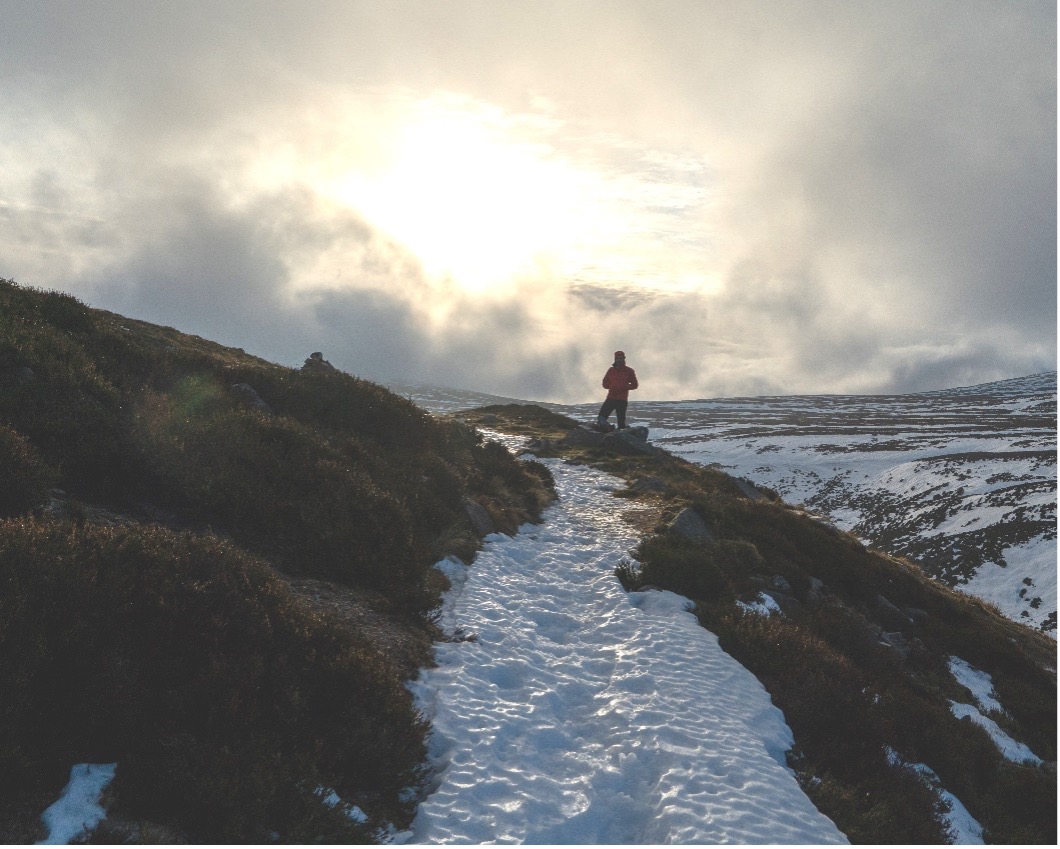
A Winter Path, Lochnagar. © Jamie Vince
Mar Lodge Estate (MLE) is the UK's largest National Nature Reserve, and is cared for by the National Trust for Scotland (NTS) for nature, highland sport and people. The challenges of managing for these three conflicting interests are tricky, especially against a background of climate change.
The challenge of reducing carbon emissions and saving moorland habitat has led to the Glen Geldie peatland restoration project which was carried out in 2024. The moorland is already showing improvements, and the project will save thousands of tonnes of carbon emissions over the next few decades.
Due to extreme weather events, key projects include bridge and path repair. Last year the Derry Dam bridge and the Allt Christie bridge were repaired, along with the East Quoich footpath.
To mitigate the effects of the rise in water temperatures in the Geldie Burn, 53 large woody structures were installed in the river to create areas of slower-flowing water, deeper and cooler pools, and increased nutrients in the water. The success or otherwise of this initiative, which is being replicated elsewhere within the Dee catchment, will be interesting given scepticism towards this practice expressed in this publication.
The size and variety of habitats on the Estate have made it difficult to measure changes in nature, but in 2024 the Ecology Team introduced tailored biodiversity monitoring. This holistic approach has provided a baseline for biodiversity across the different habitats and different altitudes, and will aid the understanding of the impacts of climate change, and the effects of projects to counter climate change, into the future. Recent projects to reduce the decline in montane willow, aspen trees and twinflower seem to have been a success.
The management of the 14 plantations on the Estate is carried out mainly for biodiversity. The long-term plan is to open up the dense planted areas, increase the deadwood resource, and utilise the timber product that comes from thinning. There is also the challenge of checking that trees are not going to fall on property, roads or people!
The challenge of running a sporting estate as well as encouraging visitors could be significant. However, the size of the Estate means that there are areas where few walkers visit. The Stalking Team has enabled reduction in the deer population, and the resultant restoration of the estate's Caledonian pinewoods has been a cornerstone of the nature work on the Estate. From 1999 to 2024 there was a 1428% increase in seedlings recorded above vegetation (e.g. heather) height. There has also been a return of montane woodland to the Estate, and the condition of the Estate's open moorland habitats has improved.
Managing visitors to the Estate, especially in a year of good weather, is a challenge in its own right. NTS rangers are present at the Linn of Dee car park every day during the school holidays to engage with visitors, manage parking, and monitor camping and other activities elsewhere.
With wildfires becoming more common, MLE is now "planning for wildfires". This includes reducing risk (signage, media alerts, and discussions with visitors) and preparing for response. In 2025, rangers encountered 60 campfires compared to 115 in 2021, showing progress.
One major effect of visitors is the disappearance of brash and deadwood around bothies on the Estate, leading to a lack of habitat for invertebrates. This has knock-on effects on bird populations.
The increasing number of visitors and the resultant human waste is becoming a serious issue in high-use areas, especially where soils are thin, such as around Loch Etchachan. Rangers are installing visitor counters, distributing tools to help visitors bury waste, and redirecting Duke of Edinburgh Award groups to reduce pressure. A renewed water quality study, similar to that carried out in 2012, may be warranted.
On the high plateau, dogs are considered more problematic than bikes. Dogs may disturb birds' nests, while bikes tend to remain on paths. MLE is working with partners to study disturbance impacts on the dotterel population.
The North East of Scotland is fortunate to have such a large area of wild land managed by a charity committed to carbon reduction and biodiversity enhancement. Achieving this requires income generation and careful visitor management - a difficult balance with many challenges.
A Winter Path, Lochnagar. © Jamie Vince
Please let the webmaster know if there are problems with viewing these pages or with the links they contain.